Articulate
7 Articulate Examples That Inspire Creativity in Online Courses
Creating engaging online courses is an art. It requires creativity, innovation, and the right tools....
Read More
Compliance training for employees is an essential aspect of workers’ education, designed to ensure they adhere to legal standards and internal policies governing workplace behaviour and actions. An employee compliance program mitigates risks by preventing legal issues, promoting safety, and cultivating a culture of transparency and responsibility. In this article, we explore why employee compliance training is crucial, delve into the typical topics covered, and provide 15 practical tips for developing an effective compliance program.
Compliance training educates employees on the laws and regulations applicable to their jobs. Mandated by law in many sectors, it is critical for maintaining an organization’s legal and ethical standards. It involves instructing employees on complying with statutory obligations and company policies, such as workplace safety, data protection, and financial regulations.
Below are examples of standard employee compliance training programs for small and medium-sized corporate entities, Non-Profits, Universities and Colleges, and Government Agencies.
Discrimination and Harassment: Training on preventing discrimination and harassment on campus, ensuring a safe and inclusive environment for all students and staff. For example, Title IX compliance (United States).
Research Compliance: Important for institutions involved in research, covering areas such as human subject research, laboratory safety, and data management.
Family Educational Rights and Privacy (FERPA in the US, Privacy and Freedom of Information in Canada): Training for staff to maintain student education records’ privacy.
Ethics and Integrity Training: Employees must understand the ethical standards and integrity expected in public service.
Information Security and Cybersecurity: Employees must receive training in protecting information assets, given the sensitivity of data handled by government agencies.
Procurement and Contract Management: Training focused on ensuring employees understand the laws and regulations governing the government’s procurement of goods and services.
Employee compliance training is crucial to an organization’s operations, regardless of size or sector. Customizing training to the organization’s specific needs and risks ensures that employees are well-informed and equipped to perform their duties in accordance with relevant laws and regulations.
The significance of compliance training extends beyond merely meeting legal requirements. Effective compliance training for employees should have benefits outside of preventing violations that could lead to costly fines or legal disputes. At a minimum, it should protect your organization’s brand and reputation. However, it should also enhance your workplace culture and empower employees with knowledge and skills.
Customizing your training to your specific circumstances is critical in achieving these higher-level outcomes.
The significance of compliance training extends beyond simply meeting legal requirements. Effective compliance training for employees should deliver benefits beyond preventing violations that could lead to costly fines or legal disputes. At a minimum, it should protect your organization’s brand and reputation. However, it should also enhance your workplace culture and empower employees with the knowledge and skills they need.
Customizing your compliance program to your specific circumstances is critical in achieving these higher-level outcomes.
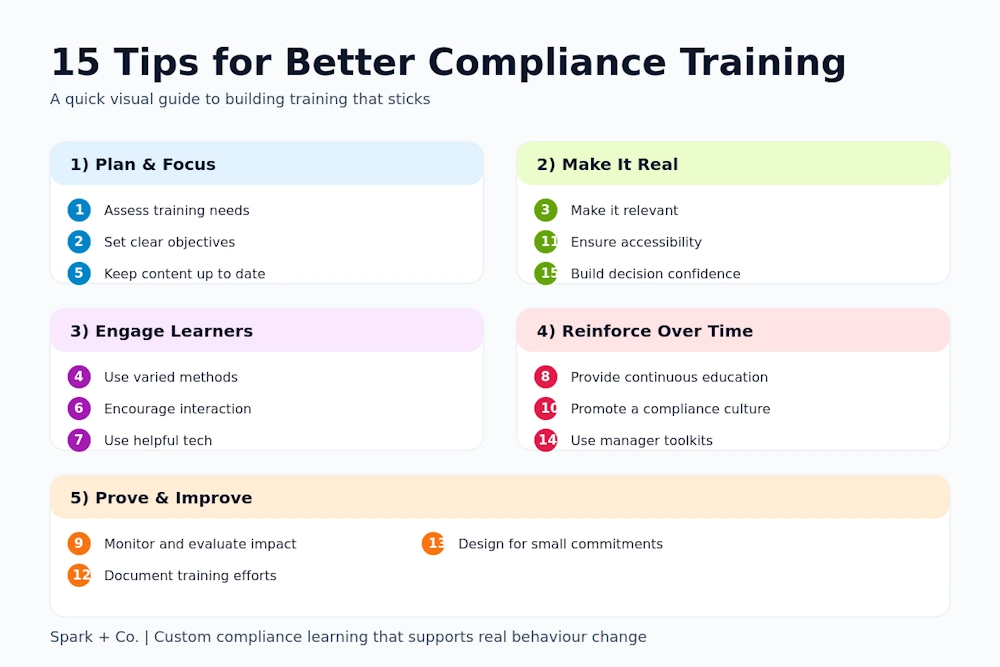
Below are 15 tips for creating highly effective employee compliance training. Depending on your circumstances, needs, and resources, you may incorporate some or all of these tips into your compliance program.
Understand the specific compliance requirements of your industry and the roles within your organization. Tailor your employee compliance training to meet these needs effectively. Know your audience and design the training for them, and not for the content. For instance, consider creating a podcast, webcomic, or another product instead of a typical elearning course if that fits your culture, brand, and needs.
Before designing your compliance program, define clear, measurable learning objectives. What should employees be able to do after completing the training?
Customize content to reflect your employees’ daily experiences and challenges. For example, relevant scenarios help to engage learners and improve retention. And don’t make them take the same compliance training every year. Instead, when you build your compliance program for employees, create a bank of scenarios they can learn from. Then, randomize the situations that they would practice in. It’s a little more expensive up front, but it has a longer shelf life and engages the learner.
Also, consider a pre-test at the start of the training course, especially for annual refresher courses. It allows knowledgeable people to ‘test out’ of parts of the training where they demonstrate competency.
Incorporate a mix of training methods, including e-learning, workshops, and simulations. This variety can cater to different compliance topics and increase engagement.
Regularly update training materials to reflect the latest legal changes and industry best practices. This ensures ongoing compliance and relevance. Also, even if laws don’t change, examples and risks do. Consider a refresh schedule such as
Interactive elements such as quizzes, discussions, and group activities can enhance understanding and retention of compliance issues. Also, decide whether to make the employee compliance training short and simple or invest more to make it compelling.
Leverage modern e-learning technologies to deliver flexible, accessible training solutions. Online platforms can offer interactive, personalized learning experiences. Perhaps consider using artificial intelligence to help create content for topics that are not industry-specific.

Compliance training for employees isn’t a one-time event. Offer ongoing training to keep pace with changes in laws and regulations and to reinforce compliance concepts. Think like a marketer and create a campaign that includes posters, job aids, competitions, and other activities to reinforce the training concepts.
Regularly assess the effectiveness of your compliance program. Use feedback and performance analysis to identify areas for improvement.
Foster an organizational culture that values compliance through regular communication, leadership examples, and recognition of compliant behaviours. Celebrate people who exhibit the right behaviours or make the right decisions; don’t just tell people what not to do.
Ensure training materials are accessible to all employees. Consider language, format, and delivery methods to accommodate diverse needs.
Keep detailed records of training activities, completion, and assessments. This documentation can be crucial for proving compliance in audits or legal challenges.
Near the end of your training programs, ask learners to choose one realistic action they’ll take this week. Then email (or LMS-nudge) a reminder later. Even one small commitment increases follow-through. For example, ask learners, “What’s the first thing you’ll do differently after this module?”
Even excellent compliance training can have a limited impact if managers don’t reinforce it. So perhaps provide a one-page manager toolkit that includes three talking points, a 10-minute team huddle outline, and two questions to ask after training. This turns “promote a compliance culture” into something leaders can actually do.
Most compliance program failures happen in gray areas, and not in obvious red-flag moments. Consider adding micro-scenarios that force learners to choose between two almost-right options, then explain and discuss the tradeoffs. The goal is to train judgment under uncertainty, not memorization.
In addition to the tips for your compliance program noted above, here are a few common traps to avoid.
Compliance training for employees doesn’t need to be dull. By following these tips, organizations can create practical and engaging compliance training for employees that meets legal requirements and promotes an ethical, informed, and safety-conscious workplace culture that empowers employees. For further insights and assistance in developing the best employee compliance training solutions, visit Spark + Co at www.sparkandco.ca, where we blend expertise with innovation to inspire your organization.